Introduction: The Evolving DevOps Landscape
DevOps has come a long way since its inception in the late 2000s. What started as a movement to bridge development and operations has evolved into a sophisticated discipline encompassing AI-powered automation, platform engineering, and security-first mindsets.
In 2026, DevOps teams face new challenges:
- AI integration becoming mandatory rather than optional
- Security concerns escalating with supply chain attacks
- Cost optimization pressures in uncertain economic times
- Developer experience emerging as a key differentiator
This article explores the top trends shaping DevOps in 2026 and beyond.
Trend 1: AI-Powered DevOps (AIOps 2.0)
From Reactive to Predictive
AIOps has matured significantly. Modern AIOps platforms don’t just alert you when something breaks — they predict failures before they happen.
Key capabilities:
- Anomaly detection: Machine learning models identify unusual patterns in metrics, logs, and traces
- Root cause analysis: AI correlates events across distributed systems to pinpoint issues
- Automated remediation: Self-healing systems automatically roll back bad deployments or scale resources
- Intelligent alerting: Reduces alert fatigue by grouping related incidents
Real-world impact:
Before AIOps:
- 200+ alerts per day
- 45 minutes mean time to detection (MTTD)
- 2 hours mean time to resolution (MTTR)

After AIOps implementation:
- 20 prioritized alerts per day
- 5 minutes MTTD
- 30 minutes MTTR
Generative AI in DevOps Workflows
Generative AI has transformed how DevOps engineers work:
- Infrastructure as Code generation: AI writes Terraform, CloudFormation, or Pulumi configurations from natural language descriptions
- Pipeline optimization: AI analyzes CI/CD pipelines and suggests improvements
- Incident response: AI-powered chatbots provide runbook guidance during incidents
- Documentation automation: AI generates and maintains runbooks, post-mortems, and knowledge bases
Example: AI-generated Terraform
# Prompt: "Create an S3 bucket with versioning and lifecycle policies"
# AI-generated output:

resource "aws_s3_bucket" "data_bucket" {
  bucket = "my-app-data-bucket"
}

resource "aws_s3_bucket_versioning" "data_bucket_versioning" {
  bucket = aws_s3_bucket.data_bucket.id
  versioning_configuration {
    status = "Enabled"
  }
}

resource "aws_s3_bucket_lifecycle_configuration" "data_bucket_lifecycle" {
  bucket = aws_s3_bucket.data_bucket.id

  rule {
    id     = "archive-old-data"
    status = "Enabled"

    transition {
      days          = 90
      storage_class = "GLACIER"
    }

    expiration {
      days = 365
    }
  }
}
Trend 2: Platform Engineering Takes Center Stage
The Rise of Internal Developer Platforms (IDPs)
Platform engineering has emerged as a dedicated discipline focused on building self-service infrastructure for development teams. The goal: reduce cognitive load on developers while maintaining guardrails.
Core components of an IDP:
- Self-service provisioning: Developers can spin up environments, databases, and services without tickets
- Golden paths: Pre-configured templates for common use cases
- Observability dashboards: Unified visibility into application health
- Policy enforcement: Automated compliance and security checks
Backstage and Open Source Platform Tools
Spotify’s Backstage has become the de facto standard for building developer portals:
# Example Backstage Software Template
apiVersion: scaffolder.backstage.io/v1beta3
kind: Template
metadata:
  name: create-microservice
  title: Create New Microservice
  description: Generates a new microservice with all required infrastructure

spec:
  owner: platform-team
  type: service

  parameters:
    - title: Service Information
      required:
        - name
        - owner
      properties:
        name:
          title: Service Name
          type: string
        owner:
          title: Team Owner
          type: string

  steps:
    - id: fetch-template
      name: Fetch Service Template
      action: fetch:template
      input:
        url: ./templates/microservice

    - id: create-repository
      name: Create GitHub Repository
      action: publish:github
      input:
        repo: ${{ parameters.name }}
        owner: my-org
Popular platform engineering tools:
| Tool | Category | Use Case |
|---|---|---|
| Backstage | Developer Portal | Service catalog and templates |
| Crossplane | Control Plane | Kubernetes-native infrastructure |
| ArgoCD | GitOps | Continuous deployment |
| Humanitec | Platform Orchestrator | Full-stack platform automation |
| Cortex | Developer Portal | Service maturity tracking |
Trend 3: GitOps Becomes the Default
Why GitOps Won
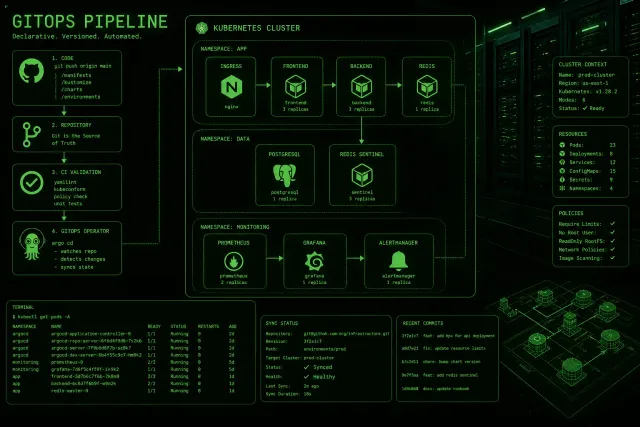
GitOps uses Git repositories as the single source of truth for infrastructure and application configurations. By 2026, over 70% of cloud-native teams have adopted GitOps practices.
Benefits driving adoption:
- Audit trail: Every change is versioned and traceable
- Rollback simplicity: Revert to previous states instantly
- Collaboration: Pull requests enable team review
- Consistency: Eliminates configuration drift
ArgoCD vs Flux: The GitOps Duopoly
Two tools dominate the GitOps space:
ArgoCD (CNCF graduated project):
- Rich UI for visualization and management
- Support for helm, kustomize, and jsonnet
- Application-level health assessment
- Multi-cluster management
Flux (also CNCF graduated):
- Lightweight and Git-native
- Strong integration with GitHub Actions
- Image automation and updates
- Simpler operational model
Example ArgoCD Application:
apiVersion: argoproj.io/v1alpha1
kind: Application
metadata:
  name: my-app
  namespace: argocd
spec:
  project: default
  source:
    repoURL: https://github.com/my-org/my-app-config
    targetRevision: HEAD
    path: apps/my-app
  destination:
    server: https://kubernetes.default.svc
    namespace: production
  syncPolicy:
    automated:
      prune: true
      selfHeal: true
    syncOptions:
      - CreateNamespace=true
Trend 4: Security Shifts Left (and Right)
DevSecOps Maturity
Security is no longer an afterthought. Modern DevOps integrates security at every stage:
Shift Left (Development):
- SAST (Static Application Security Testing) in CI/CD
- Dependency scanning for vulnerabilities
- Infrastructure as Code security analysis
- Secret detection in code repositories
Shift Right (Production):
- Runtime application self-protection (RASP)
- Continuous vulnerability scanning
- Threat detection and response
- Security chaos engineering
Supply Chain Security Takes Priority
Following high-profile attacks like SolarWinds, supply chain security has become critical:
SLSA (Supply-chain Levels for Software Artifacts):
- Framework for securing software supply chains
- Levels 1-4 define increasing security guarantees
- Major vendors (Google, GitHub, Docker) now support SLSA
Implementation example:
# GitHub Actions with SLSA attestation
jobs:
  build:
    outputs:
      digests: ${{ steps.build.outputs.digests }}
    runs-on: ubuntu-latest
    steps:
      - uses: actions/checkout@v4

      - name: Build and attest
        id: build
        uses: slsa-framework/slsa-github-generator/.github/actions/builder@v1.9.0
        with:
          command: ./build.sh
Key tools:
- Sigstore/Cosign: Container signing and verification
- SLSA generators: Automated provenance generation
- Dependency track: Software Bill of Materials (SBOM) management
- Chainguard: Hardened container images
Trend 5: FinOps Integration
Cost Optimization as a DevOps Priority
With cloud bills consuming larger portions of IT budgets, FinOps (Financial Operations) has become essential:
FinOps practices:
- Resource rightsizing: Match resources to actual usage
- Spot instance utilization: Leverage spare cloud capacity
- Reserved capacity planning: Commit to predictable workloads
- Cost allocation: Attribute costs to teams and products
Example: Kubernetes cost optimization
# Vertical Pod Autoscaler for rightsizing
apiVersion: autoscaling.k8s.io/v1
kind: VerticalPodAutoscaler
metadata:
  name: my-app-vpa
spec:
  targetRef:
    apiVersion: apps/v1
    kind: Deployment
    name: my-app
  updatePolicy:
    updateMode: Auto
  resourcePolicy:
    containerPolicies:
      - containerName: '*'
        minAllowed:
          cpu: 100m
          memory: 128Mi
        maxAllowed:
          cpu: 1
          memory: 1Gi
Popular FinOps tools:
| Tool | Provider | Key Features |
|---|---|---|
| AWS Cost Explorer | AWS | Native AWS cost analysis |
| Kubecost | Kubecost | Kubernetes cost monitoring |
| CloudHealth | VMware | Multi-cloud cost management |
| Datadog Cloud Cost Management | Datadog | Integrated with observability |
Trend 6: Edge Computing and Distributed DevOps
The Edge DevOps Challenge
Edge computing brings computation closer to data sources. This creates unique DevOps challenges:
- Distributed deployments: Managing thousands of edge nodes
- Intermittent connectivity: Handling offline scenarios
- Resource constraints: Operating on limited hardware
- Security at scale: Protecting distributed infrastructure
Edge-Native Tools
K3s and MicroK8s: Lightweight Kubernetes distributions for edge KubeEdge: CNCF project extending Kubernetes to edge Azure Arc: Multi-cloud and edge management AWS Greengrass: IoT edge computing platform
Example K3s deployment:
# Install K3s on edge node
curl -sfL https://get.k3s.io | sh -

# Deploy application
kubectl apply -f edge-app.yaml

# Monitor edge cluster
k3s kubectl get nodes
k3s kubectl top pods
Trend 7: Developer Experience (DevEx) as Competitive Advantage
Why DevEx Matters
Teams with excellent developer experience ship faster and retain talent better. Key metrics:
- Lead time: How long from code commit to production?
- Deployment frequency: How often can you deploy?
- Change failure rate: What percentage of deploys cause issues?
- Time to restore: How quickly can you recover from failures?
DevEx Best Practices
- Local development environments: Use dev containers and local Kubernetes (kind, k3d)
- Fast feedback loops: Optimize CI/CD for speed
- Comprehensive documentation: Maintain living docs
- Automated testing: Reduce manual verification
- Blameless culture: Focus on learning from failures
Dev Container example:
{
  "name": "Node.js Development",
  "image": "mcr.microsoft.com/devcontainers/javascript-node:20",
  "features": {
    "ghcr.io/devcontainers/features/docker-in-docker:2": {},
    "ghcr.io/devcontainers/features/kubectl-helm-minikube:1": {}
  },
  "customizations": {
    "vscode": {
      "extensions": [
        "dbaeumer.vscode-eslint",
        "esbenp.prettier-vscode"
      ]
    }
  },
  "forwardPorts": [3000]
}
Trend 8: Observability Evolution
From Three Pillars to Unified Observability
Traditional observability separated metrics, logs, and traces. Modern platforms unify them:
Unified observability benefits:
- Correlate signals automatically
- Single pane of glass for debugging
- Reduced tool sprawl
- Cost efficiency through consolidation
OpenTelemetry Dominance
OpenTelemetry has won the instrumentation war:
# OpenTelemetry Collector configuration
receivers:
  otlp:
    protocols:
      grpc:
      http:

processors:
  batch:
  memory_limiter:
    limit_mib: 1000

exporters:
  prometheus:
    endpoint: "0.0.0.0:8889"
  otlp/jaeger:
    endpoint: jaeger-collector:4317

service:
  pipelines:
    metrics:
      receivers: [otlp]
      processors: [batch]
      exporters: [prometheus]
    traces:
      receivers: [otlp]
      processors: [batch]
      exporters: [otlp/jaeger]
Leading observability platforms:
- Grafana Labs (open source + cloud)
- Datadog (enterprise)
- New Relic (full-stack)
- Honeycomb (debugging-focused)
Summary: What’s Next for DevOps
DevOps in 2026 is defined by:
- AI integration at every level — from code generation to incident response
- Platform engineering reducing developer cognitive load
- GitOps as the standard deployment pattern
- Security embedded throughout the lifecycle
- Cost consciousness driving optimization
- Edge computing expanding the DevOps perimeter
- Developer experience as a strategic priority
- Unified observability powered by OpenTelemetry
Recommended Next Steps
- Audit your toolchain: Identify gaps in automation, security, and observability
- Experiment with AI: Start with low-risk use cases like documentation
- Invest in platform: Build golden paths for common workflows
- Embrace GitOps: Migrate to Git-based deployment workflows
- Measure DevEx: Track DORA metrics and developer satisfaction
Resources: