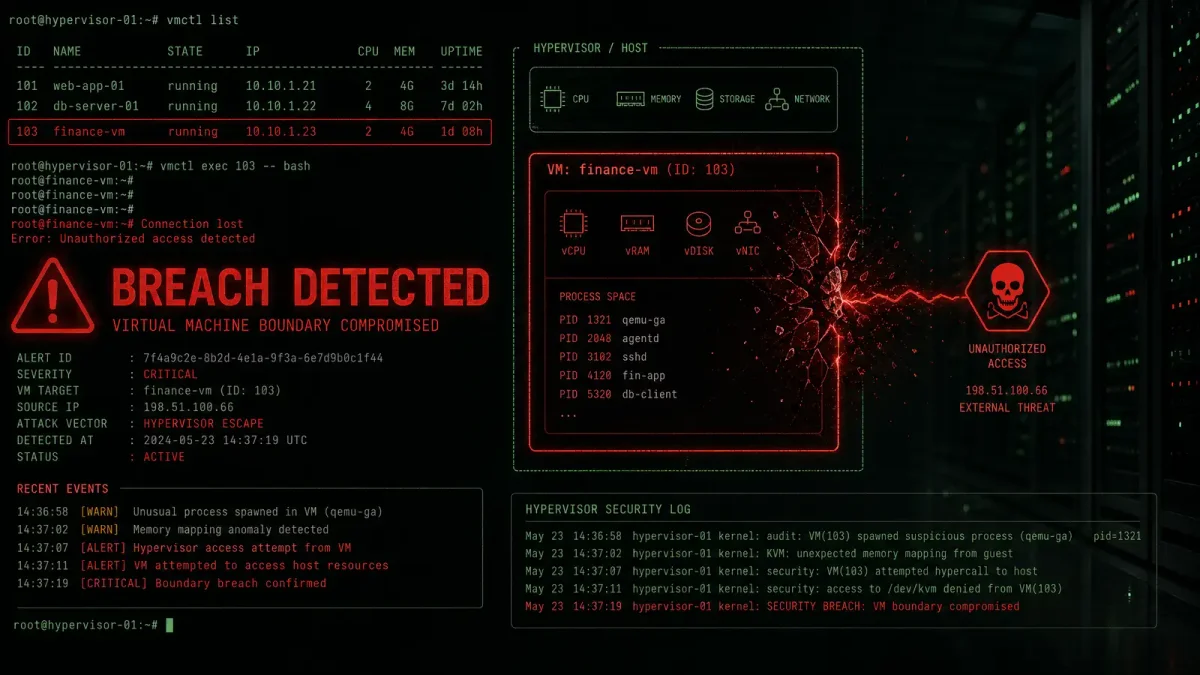
Security researchers have disclosed a critical vulnerability in the Linux kernel’s Kernel-based Virtual Machine (KVM) hypervisor that has gone undetected for 16 years. Tracked as CVE-2026-53359 and nicknamed “Januscape,” the flaw allows an attacker with code execution inside a guest VM to escape the virtualized environment and run arbitrary code on the underlying host system.
The vulnerability affects the shadow Memory Management Unit (MMU) implementation in KVM, which is the hypervisor component responsible for translating guest physical addresses to host physical addresses. Both Intel and AMD systems running KVM are affected, which covers the vast majority of cloud infrastructure, virtual private servers, and enterprise virtualization deployments worldwide.
How Januscape Works
The shadow MMU is a software implementation that KVM uses when hardware-assisted virtualization features like Intel EPT (Extended Page Tables) or AMD NPT (Nested Page Tables) are either unavailable or disabled. In these configurations, KVM maintains a shadow page table that maps guest memory accesses to the correct host physical addresses.
The Januscape flaw resides in how the shadow MMU handles certain page table entry invalidations during concurrent operations. Under specific race conditions — which researchers were able to trigger reliably from within a guest VM — the hypervisor can be tricked into mapping a guest-controlled page into host kernel memory space. Once that happens, the attacker can read and write arbitrary host memory, escalate privileges to root, and effectively take full control of the physical server.
The vulnerability designation “Januscape” comes from Janus, the Roman god of doorways and transitions, reflecting the attack’s ability to move through the boundary between guest and host. The “scape” suffix invokes the escape nature of the exploit.
Scope and Severity
This is not a theoretical concern. A proof-of-concept exploit has already been published, and the vulnerability received a CVSS score of 8.8 (High). Any Linux server running KVM with shadow paging enabled is potentially vulnerable, which includes:
- Cloud providers using KVM as their hypervisor layer
- On-premises virtualization hosts running QEMU/KVM
- VPS hosting platforms where customers share physical hardware
- Development and testing environments using libvirt or virt-manager
- Container-optimized Linux distributions that include KVM modules
Systems using hardware-assisted paging (EPT/NPT) are not directly exploitable through this specific vector, but the shadow MMU fallback can be forced under certain conditions, such as when live-migrating VMs between hosts with different CPU feature sets.
Detection and Mitigation
Check if your system is affected
First, verify whether your KVM configuration uses shadow paging:
# Check if KVM module is loaded
lsmod | grep kvm

# Check if nested paging is active (EPT on Intel, NPT on AMD)
cat /sys/module/kvm_intel/parameters/ept    # Intel - should be Y
cat /sys/module/kvm_amd/parameters/npt      # AMD - should be 1
If hardware paging is enabled and actively in use, you’re partially protected — but don’t rely on this alone. Kernel updates should still be applied.
Patch immediately
The fix has been backported to all supported Linux kernel branches. Update your kernel to the latest version from your distribution:
# Debian/Ubuntu
sudo apt update && sudo apt upgrade linux-image-$(uname -r)

# RHEL/CentOS/Rocky/Alma
sudo dnf update kernel

# Check kernel version after reboot
uname -r
For systems that cannot be rebooted immediately, consider live-patching solutions like KernelCare or Canonical Livepatch if your distribution supports them. The specific commit that fixes CVE-2026-53359 modifies the arch/x86/kvm/mmu/spte.c file and related MMU invalidation paths — applying this patch through a live-patching service will close the vulnerability without downtime.
Hardening measures
While patching is the definitive fix, server administrators can take additional steps to reduce exposure:
- Disable KVM on systems that don’t need virtualization. If the server is a dedicated application host with no VM workloads, remove or blacklist the KVM kernel modules.
- Audit your hypervisor configurations to ensure hardware-assisted paging is enabled wherever possible. Most modern CPUs (Intel since Nehalem, AMD since Barcelona) support this feature.
- Review VM isolation policies. In multi-tenant environments, ensure that VMs from different trust levels are not co-located on the same physical host when avoidable.
- Monitor for unusual kernel messages related to KVM MMU operations. Unexpected page fault patterns or shadow page table flushes can be early indicators of exploitation attempts.
What Makes This Different
The security community is still processing the Januscape disclosure alongside another major Linux vulnerability from the same week — the “Bad Epoll” flaw, which we covered separately. While Bad Epoll allows local privilege escalation from an unprivileged user to root, Januscape targets a different attack surface entirely: the boundary between virtualized guests and their host. For cloud providers and hosting companies, a VM escape vulnerability is arguably more dangerous than a local privilege escalation, because it breaks the fundamental isolation guarantee that multi-tenant cloud infrastructure depends on.
The 16-year lifespan of this bug — it was introduced in a kernel commit from 2010 — is a sobering reminder that even heavily audited code paths in critical infrastructure can harbor vulnerabilities for decades. The KVM subsystem receives regular security review, yet this race condition in the shadow MMU escaped detection through multiple kernel generations. It’s a strong argument for the defense-in-depth approach: never assume that any single layer of isolation is impenetrable.
Patch your kernels this week. If you’re running KVM in production, this one isn’t optional.