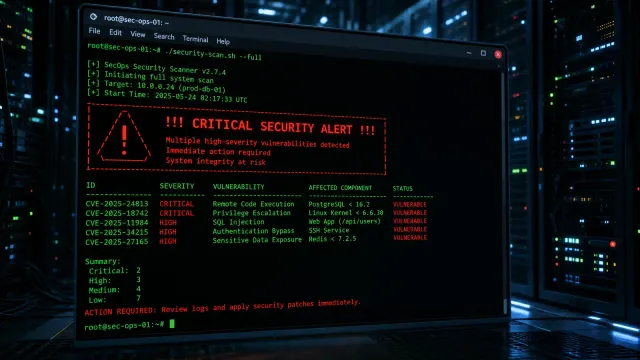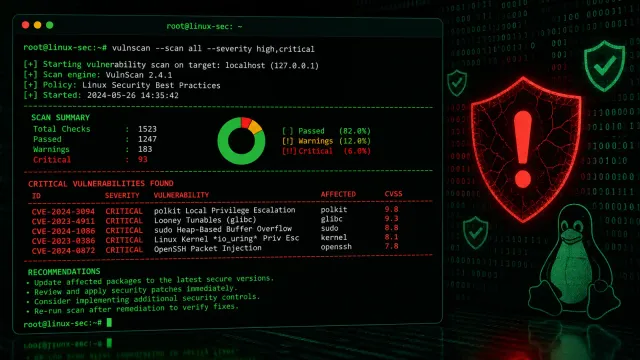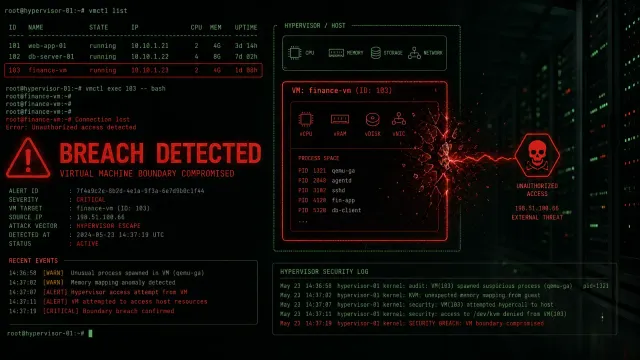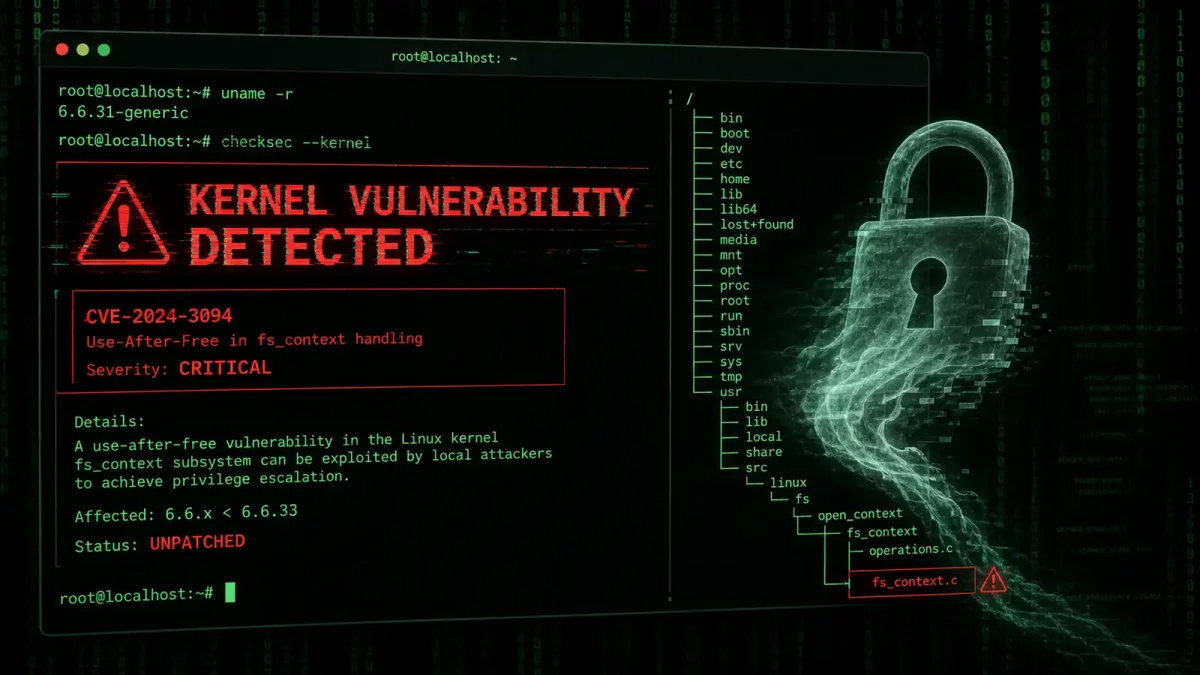
Security researchers at Nebula Security have published full technical details and working exploit code for a use-after-free vulnerability that has been sitting in the Linux kernel since May 2011. Tracked as CVE-2026-43499 and nicknamed “GhostLock,” the flaw allows any local user — no special permissions, no setuid binaries, no complex race-condition gymnastics required — to escalate to root on an unpatched machine. The proof-of-concept exploit is 97% reliable in testing and also functions as a container escape.
The vulnerability was discovered by Vega, Nebula’s AI-assisted vulnerability scanner, and earned the team a $92,337 bounty through Google’s kernelCTF program. A patch landed in the upstream kernel in April 2026, but as of early July, Canonical’s Ubuntu CVE tracker still lists 24.04, 22.04, and 20.04 LTS releases as vulnerable with patch status “in progress.” If you manage Linux servers, this is your wake-up call.
What GhostLock Actually Does
GhostLock lives inside a kernel helper function in the real-time scheduling subsystem — specifically, the path that handles task cleanup when a high-priority operation completes or is preempted. The Linux kernel’s real-time scheduler (the SCHED_DEADLINE class, introduced around the same time this bug was born) uses a mechanism called “requeue” to move tasks between runqueues when priority inheritance or deadline enforcement kicks in.
Here is the normal sequence. A task finishes executing, the kernel calls the cleanup function, and the function releases the task’s kernel-side metadata: stack references, signal struct pointers, and memory descriptor links. Everything gets zeroed out, and the task struct is returned to the slab allocator. Clean, predictable, boring.
The bug triggers when a deadlock is detected mid-cleanup. The kernel rolls back the operation, but the rollback path makes an incorrect assumption: it always frees memory belonging to the current task. When a requeue was in flight before the deadlock, the cleanup function has already switched its target to a different, sleeping thread. The rollback frees the sleeping thread’s memory, but the current task still holds a live pointer to it. That dangling pointer is the entry point for exploitation.
This is not a theoretical race condition that requires a supercomputer to trigger. The real-time scheduler’s requeue mechanism is deterministic — if you know the task priority values and the deadline parameters, you can calculate the exact timing window. Nebula’s exploit does exactly this: it creates two threads with carefully chosen SCHED_DEADLINE parameters, forces a priority inversion that triggers the requeue path, and simultaneously issues a syscall from a third thread that hits the cleanup function. The deadlock detection fires within microseconds, and the rollback frees the wrong task’s memory. From there, the exploit sprays the freed slab with fake cred structures using heap Feng Shui, and the kernel — still holding the dangling pointer — reads the attacker’s crafted root credentials as if they were legitimate, setting the attacking process’s UID to 0.
The exploit achieved a 97% success rate across hundreds of test runs on kernel versions spanning 5.15 through 6.8. It also escaped Docker and containerd containers by exploiting the shared kernel, meaning a compromised container on a multi-tenant host becomes a full host compromise.
Scope: What Is Actually Affected
The vulnerability was introduced in commit a841f8c to kernel/sched/core.c in Linux 2.6.39, released on May 18, 2011. Every major distribution that shipped a kernel based on 2.6.39 or later is affected unless the April 2026 patch has been applied. That is effectively every Linux distribution still in active use.
Here is the distribution-by-distribution picture as of July 14, 2026:
Ubuntu: All LTS releases — 20.04 (kernel 5.4), 22.04 (kernel 5.15 / 6.5 HWE), and 24.04 (kernel 6.8) — are vulnerable. Ubuntu’s CVE tracker shows patches as “in progress” rather than “released” for all three. If you subscribe to Ubuntu Pro with Livepatch, check whether CVE-2026-43499 is covered in your livepatch timeline; kernel livepatching cannot fix every class of use-after-free without a reboot.
Debian: Bookworm (12, kernel 6.1), Bullseye (11, kernel 5.10), and Trixie (13, kernel 6.12) all ship kernels in the affected range. Debian’s security team typically backports fixes to stable within days, but verify your mirror has synced.
RHEL / CentOS Stream / Rocky / AlmaLinux: RHEL 8 (kernel 4.18) and RHEL 9 (kernel 5.14) are affected. Red Hat backports fixes to their kernel packages rather than bumping versions, so you need the specific errata, not just a newer kernel number. Check dnf updateinfo list --cve CVE-2026-43499 for your specific build.
Amazon Linux: AL2 (kernel 4.14 / 5.10) and AL2023 (kernel 6.1) are both vulnerable. AWS typically ships kernel updates through yum update kernel within 24-48 hours of upstream patch availability.
SUSE / openSUSE: SLES 15 SP4 through SP6 (kernel 5.14 / 6.4) are affected. SUSE’s live-patching infrastructure covers this CVE class, so livepatch subscribers may already be protected.
Container-optimized distributions: Bottlerocket, Flatcar Container Linux, and Google’s Container-Optimized OS all run affected kernel versions. Since these distributions minimize local user access by design, the immediate risk is lower — but the container escape vector means any compromised workload on these hosts becomes a path to the node.
The CVSS score is 7.8 (High), with the vector string CVSS:3.1/AV:L/AC:L/PR:L/UI:N/S:U/C:H/I:H/A:H — local attack, low complexity, low privileges required, no user interaction, full confidentiality/integrity/availability impact.
How to Check If Your Servers Are Affected
Start with the kernel version, but do not stop there. Several distributions backport fixes without bumping the version string, so the kernel number alone can be misleading.
# Step 1: Identify the running kernel
uname -r

# Step 2: Check the changelog for the CVE (Debian/Ubuntu)
apt changelog linux-image-$(uname -r) 2>/dev/null | grep -i "CVE-2026-43499"
# If this returns nothing, the fix is not present.

# Step 3: For RHEL-family systems
rpm -q --changelog kernel-$(uname -r) 2>/dev/null | grep -i "CVE-2026-43499"

# Step 4: For Ubuntu LTS users, query the CVE tracker directly
pro fix CVE-2026-43499 2>/dev/null
# Or use the web API
curl -s https://ubuntu.com/security/CVE-2026-43499 2>/dev/null | \
  grep -oP '(Released|Needed|Pending|DNE|Deferred)' | head -1
For environments with dozens or hundreds of servers, an Ansible ad-hoc check is faster:
ansible all -m shell -a \
  "apt changelog linux-image-\$(uname -r) 2>/dev/null | grep -q 'CVE-2026-43499' && echo PATCHED || echo VULNERABLE"
Container-specific check: Since containers share the host kernel, checking from inside a container tells you about the host. Run uname -r inside any container on the host — if it returns a vulnerable kernel version and the host has not been patched, every container on that host is exposed to GhostLock’s container escape. This is the scenario that should worry anyone running multi-tenant container platforms.
How to Patch
The fix is a kernel update, and kernel updates require a reboot unless you use live-patching. Here are the distribution-specific commands:
# Ubuntu / Debian
sudo apt update
sudo apt install --only-upgrade linux-image-generic linux-headers-generic
sudo reboot

# RHEL / Rocky / AlmaLinux / CentOS Stream
sudo dnf update kernel
# Verify the specific errata is in the update
dnf updateinfo info --cve CVE-2026-43499
sudo reboot

# Amazon Linux 2 / 2023
sudo yum update kernel
sudo reboot

# SUSE / openSUSE
sudo zypper patch --cve=CVE-2026-43499
sudo reboot
After reboot, confirm the new kernel is running and the CVE is patched:
uname -r
# Should show a kernel build date after April 2026, or a version with the backported fix

# Verify the CVE is in the changelog
apt changelog linux-image-$(uname -r) 2>/dev/null | grep "CVE-2026-43499"
If you cannot reboot immediately
Several mitigations reduce exposure until a maintenance window opens, though none fully prevent exploitation:
Restrict local shell access:
# Audit all users with login shells
awk -F: '($7 !~ /(nologin|false|sync|halt|shutdown)/)' /etc/passwd

# Remove shell access for service accounts
sudo usermod -s /usr/sbin/nologin www-data
sudo usermod -s /usr/sbin/nologin mysql
Harden container runtime security:
# Drop dangerous capabilities from Docker containers
docker run --cap-drop=ALL --cap-add=NET_BIND_SERVICE ...

# For Kubernetes, apply a restrictive PodSecurityPolicy or Pod Security Standard
# that blocks privileged containers and host PID namespace access
Enable kernel auditing for privilege escalation attempts:
# Log all execve calls that result in root
sudo auditctl -a always,exit -F arch=b64 -S execve -F euid=0 -k root-exec
sudo auditctl -a always,exit -F arch=b32 -S execve -F euid=0 -k root-exec

# Check logs for unexpected root executions
sudo ausearch -k root-exec --start today
Apply seccomp profiles: If you control the application runtime, a seccomp profile that blocks the specific syscalls used in the GhostLock exploit chain — sched_setattr, sched_getattr, and sched_yield — can break the exploit. However, this may also break legitimate real-time applications, so test thoroughly.
All of these are stopgaps. GhostLock attacks kernel memory directly; userspace hardening cannot fully prevent it. Schedule the reboot.
The Bigger Pattern: AI Is Digging Up Decades-Old Bugs
GhostLock did not announce itself through a crashing server or a suspicious log entry. It was found by Vega, Nebula Security’s AI-assisted vulnerability scanner, which analyzed kernel source code paths for use-after-free patterns and traced them through scheduling subsystem call graphs — a type of analysis that would take a human reviewer weeks for each subsystem.
This is not an isolated case. In the first half of 2026 alone, Linux kernel vulnerabilities with lifetimes measured in years or decades have been disclosed at an accelerating pace. Januscape (CVE-2026-53359) spent 16 years in the KVM hypervisor before researchers demonstrated a working VM escape. Bad Epoll (CVE-2026-57633) sat in the kernel since 2012, providing an unprivileged root escalation path on both Linux servers and Android devices. DirtyClone (CVE-2026-43503) was introduced in kernel 6.1 during a networking stack refactor and went unnoticed for over two years.
The common denominator is age. Each of these bugs predates modern static analysis tooling, kernel fuzzing infrastructure like syzkaller, and the structured CVE ecosystem that now tracks kernel vulnerabilities. They were written into the kernel during an era when security review of scheduler and memory management code was less rigorous than it is today — and they survived every subsequent release because the conditions that trigger them are rare enough to evade fuzzing but reproducible enough for a determined attacker.
For server administrators, the implication is uncomfortable but inescapable: any kernel running on your infrastructure almost certainly contains undiscovered vulnerabilities of comparable severity. The question is not whether they exist but whether they will be found by researchers with bug bounties or by attackers with different motives.
Google’s kernelCTF program, which awarded the GhostLock bounty, has now paid out over $2 million in rewards since its expansion in 2024. The program specifically targets vulnerabilities that affect Google’s container infrastructure, and the fact that GhostLock achieved container escape put it directly in the program’s crosshairs. Other organizations running large-scale container platforms — cloud providers, SaaS companies, and any business using Kubernetes at scale — should assume that similar bugs exist and are actively being sought by both bounty hunters and adversaries.
What You Should Do Right Now
If you take away nothing else from this article, execute these four steps today:
First, check every Linux host. Run the detection commands in the “How to Check” section on every server you manage — production, staging, development, and CI runners. Do not assume your configuration management system caught this. Ubuntu’s delayed patch rollout means even fully-managed environments may be exposed.
Second, prioritize multi-tenant hosts. Any server that runs containers belonging to different users or teams — Kubernetes worker nodes, VPS hosts, shared development servers — moves to the top of the patch queue. GhostLock’s container escape capability transforms a single compromised container into a full node takeover.
Third, verify, do not trust status pages. A distribution’s CVE tracker showing “fix released” does not mean the fix is installed on your servers. Run the changelog grep on every host. If you use Ubuntu Pro or RHEL live-patching, confirm with your vendor that CVE-2026-43499 is in the covered set — not all use-after-free bugs are patchable without a reboot.
Fourth, revisit your kernel update cadence. If you defer kernel updates because rebooting is operationally painful, GhostLock — and the dozen similar CVEs disclosed this year — should prompt a policy review. Live-patching services from Canonical, Red Hat, and KernelCare cover many kernel CVEs, and the operational cost of a livepatch is a fraction of the cost of a root compromise on a multi-tenant host.
The patch exists. The exploit is public. The only variable left is how long your servers remain unpatched before someone tests that 97% success rate against them.