Why This Release Matters
Linus Torvalds pushed the Linux 7.1 kernel out on Sunday, June 14, 2026 — half a day ahead of schedule due to his travel plans. For server administrators, that timing is a small detail on top of a release that packs genuine improvements to storage handling, security sandboxing, and CPU power management.
If you run production Linux servers, you should care about three things in this release:
- A completely rewritten NTFS driver that finally handles writes properly
- Landlock security getting a meaningful expansion for socket-level sandboxing
- Power management refinements that matter for both cloud instances and bare metal
Here’s what changed, what it means for your infrastructure, and how to plan your upgrade.
The New NTFS Driver: Four Years in the Making
This is the headline feature of Kernel 7.1. The old ntfs3 driver had read support for years, but write capabilities were limited and unreliable. The new implementation brings full write support with several architectural improvements:
What Actually Changed
- Delayed allocation — The driver now batches write operations before committing them to disk, similar to how ext4 and Btrfs handle allocation. This reduces fragmentation and improves throughput for large file operations.
- iomap integration — The new driver uses the modern iomap infrastructure instead of the older buffer_head approach. This means better alignment with how the kernel handles I/O across other file systems.
- folio integration — Moving to folios (the kernel’s newer memory representation for multi-page blocks) improves write performance, especially on systems with large memory pages.
- ntfsprogs-plus — A new userspace utility suite ships alongside the driver for formatting, checking, and repairing NTFS volumes.
Why Server Admins Should Care
If your servers dual-boot, mount Windows shared storage, or handle cross-platform file exchanges, the old NTFS driver was a liability. Copying large files to NTFS volumes could corrupt metadata. That should no longer be the case.
For multi-tenant hosting providers who offer Windows-compatible storage pools, this update makes Linux a more reliable backend. The delayed allocation alone should produce measurable throughput gains on sequential writes.
What to Watch For
As with any new file system driver, run it in a non-production environment first. The driver is new code with four years of development behind it, but real-world workloads surface edge cases that test suites miss. Mount with explicit options and monitor dmesg for any driver-level warnings during your testing period.
Landlock Security: Unix Domain Socket Protection
Landlock is a Linux Security Module (LSM) that lets unprivileged processes restrict their own access to the file system. It’s designed for sandboxing — a web server process can lock itself down so that even if it’s compromised, the attacker can’t read files outside its designated directory.
Kernel 7.1 extends Landlock with a new access right for pathname-based UNIX domain sockets.
The Problem It Solves
Before this change, Landlock could restrict file access but had no mechanism to control socket-based communication. A sandboxed process could still connect to arbitrary Unix domain sockets on the system, which creates an attack surface. Services like D-Bus, systemd sockets, and container runtimes all communicate through Unix domain sockets.
How It Works
The new LSM hook lets you define rules like:
# Conceptual Landlock rule (applied via landlock-tool or library)
# Allow connections only to specific socket paths
landlock-add-rule --allow-socket-connect /run/my-service.sock
landlock-add-rule --deny-socket-connect /run/*
In practice, you’d use the Landlock library from your application code. Here’s what a minimal implementation looks like:
#include <linux/landlock.h>

struct landlock_ruleset_attr attr = {
    .handled_access_fs = LANDLOCK_ACCESS_FS_EXECUTE |
                         LANDLOCK_ACCESS_FS_READ_FILE,
    .handled_access_unix = LANDLOCK_ACCESS_UNIX_CONNECT,
};

int ruleset_fd = landlock_create_ruleset(&attr, sizeof(attr), 0);
// Add path and socket rules, then enforce
landlock_restrict_self(ruleset_fd, 0);
Server Impact
For containerized workloads running directly on the kernel (without Docker’s seccomp/AppArmor layers), this gives you fine-grained socket-level isolation. For traditional server setups, it’s a defense-in-depth layer that limits lateral movement if a service gets compromised.
Power Management Improvements
Kernel 7.1 brings refinements to two CPU frequency scaling drivers that handle how the kernel manages processor speed and idle states.
amd-pstate Driver
The amd-pstate driver, which replaced the older acpi-cpufreq for AMD processors, gets improved frequency scaling behavior. The driver now interacts more efficiently with the processor’s CPPC (Collaborative Processor Performance Control) interface, resulting in:
- Faster frequency transitions when workload changes
- Better idle power savings for burst-workload servers
- Reduced latency when scaling from idle to full performance
For AMD-based servers — particularly EPYC systems running database or web workloads — this translates to lower power consumption during idle periods without sacrificing peak performance.
intel_idle Driver
The intel_idle driver, which manages C-states (idle states) on Intel processors, receives similar refinements. The improvements focus on:
- Deeper C-state entry for longer idle periods
- Faster exit latency from shallow C-states
- Better coordination with the CPU’s hardware P-states
Checking Your Current Driver
# Check which CPU frequency driver is active
cat /sys/devices/system/cpu/cpu0/cpufreq/scaling_driver

# Expected outputs:
# amd-pstate (AMD systems with Kernel 7.1)
# intel_pstate (Intel systems)
# acpi-cpufreq (fallback driver)

# View current governor
cat /sys/devices/system/cpu/cpu0/cpufreq/scaling_governor

# Common governors:
# performance - Max frequency always
# powersave   - Dynamic scaling (recommended for most servers)
# schedutil   - Scheduler-driven scaling
exFAT Preallocation Without Zeroing
This is a smaller change but worth noting for servers that use exFAT-formatted external drives or USB storage for backup rotation.
The old behavior zeroed out newly allocated clusters before assigning them to a file. This meant writing a 10 GB file to an exFAT drive actually involved writing 10 GB of zeros followed by 10 GB of real data — doubling the I/O.
Kernel 7.1 skips the zeroing step for preallocated clusters. For backup workflows that write large sequential files to exFAT drives, this cuts write time roughly in half and reduces wear on SSD-based external drives.
# Check your kernel's exFAT support
modprobe exfat
dmesg | grep -i exfat

# Verify preallocation behavior (Kernel 7.1+)
# Mount with explicit options for testing
mount -t exfat /dev/sdb1 /mnt/backup -o flush
Intel FRED Support
Intel FRED (Flexible Return and Event Delivery) is a hardware feature on Panther Lake and newer CPUs that improves interrupt and exception handling performance. Kernel 7.1 adds initial support.
For server administrators, this matters if you’re planning hardware refreshes. Servers running Panther Lake Xeons (or later) will benefit from reduced interrupt latency — meaningful for high-throughput networking and I/O-heavy workloads.
If you’re not on Panther Lake hardware yet, this change has no effect on your current systems.
Other Notable Changes
| Feature | Impact |
|---|---|
| Older AMD Radeon GPU improvements | Better display driver support on workstations; minimal server impact |
| Intel Arc Battlemage graphics | Relevant for GPU passthrough VMs on Intel Arc hardware |
| Various bug fixes from LLM-reported issues | Stability improvements across subsystems |
Upgrade Planning
Before You Upgrade
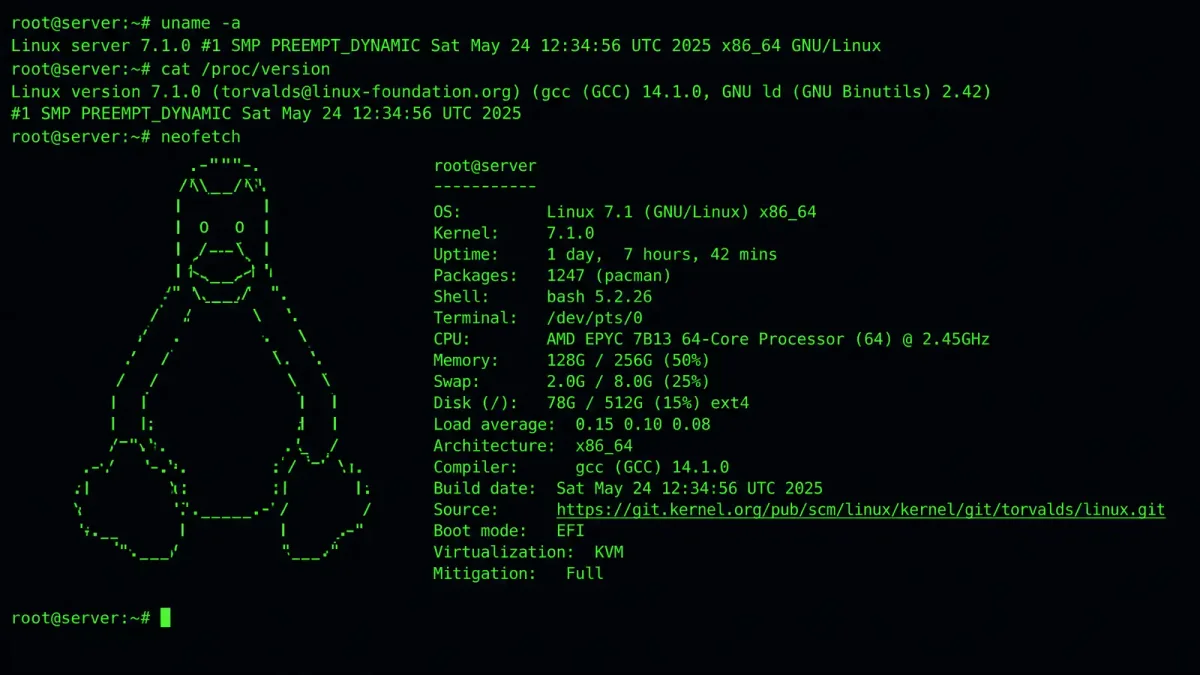
# 1. Check current kernel version
uname -r

# 2. Review installed kernel packages
dpkg --list | grep linux-image  # Debian/Ubuntu
rpm -qa | grep kernel           # RHEL/CentOS

# 3. Ensure you have a fallback kernel entry
grep menuentry /boot/grub/grub.cfg | head -5

# 4. Back up critical data
# Always. Every time.

# 5. Review kernel-specific configurations
cat /etc/default/grub | grep GRUB_CMDLINE_LINUX
Upgrade on Ubuntu/Debian
# Enable the hardware enablement stack if not already active
sudo apt update
sudo apt install --install-recommends linux-generic-hwe-24.04

# Or use mainline kernels for bleeding-edge (not recommended for production)
# Visit: https://kernel.ubuntu.com/~kernel-ppa/mainline/

# After installation, reboot and verify
sudo reboot
uname -r  # Should show 7.1.x
Upgrade on RHEL/CentOS
# For RHEL-based systems, kernel updates come through the standard repos
sudo dnf update kernel

# For ELRepo mainline kernels
sudo dnf --enablerepo=elrepo-kernel install kernel-ml

# Set default kernel if multiple are installed
sudo grubby --set-default /boot/vmlinuz-7.1.*

sudo reboot
Verification After Reboot
# Confirm kernel version
uname -r

# Check that critical modules loaded
lsmod | grep ntfs3
lsmod | grep landlock

# Verify file system mounts are healthy
mount | grep -E "ntfs|exfat"

# Check for any kernel warnings
dmesg | grep -i "error\|warn\|fail" | tail -20

# Run a quick system health check
systemctl is-system-running
Rollback Plan
Things don’t always go smoothly. Here’s your rollback strategy:
# 1. At boot, hold Shift (BIOS) or press Esc (UEFI) to show GRUB menu
# 2. Select "Advanced options for Ubuntu/RHEL"
# 3. Choose the previous kernel version
# 4. Once booted, remove the problematic kernel:
sudo apt remove linux-image-7.1.*    # Debian/Ubuntu
sudo dnf remove kernel-7.1.*         # RHEL

# 5. Update GRUB to remove the entry
sudo update-grub                     # Debian/Ubuntu
sudo grub2-mkconfig -o /boot/grub2/grub.cfg  # RHEL
Testing the NTFS Driver Before Production
Before deploying to production, run through this checklist:
# 1. Create a test NTFS volume (loop device for safety)
dd if=/dev/zero of=/tmp/ntfs-test.img bs=1M count=512
sudo mkfs.ntfs /tmp/ntfs-test.img

# 2. Mount it
sudo mkdir -p /mnt/ntfs-test
sudo mount -o loop /tmp/ntfs-test.img /mnt/ntfs-test

# 3. Write test files
sudo dd if=/dev/urandom of=/mnt/ntfs-test/testfile bs=1M count=100
sudo sync

# 4. Verify integrity
sudo ntfsfix /dev/loop0  # Or check with ntfsprogs-plus

# 5. Measure write performance
sudo dd if=/dev/zero of=/mnt/ntfs-test/perf-test bs=1M count=500 oflag=direct
# Compare output with your baseline from the old driver
Monitor the kernel ring buffer during these tests for any error messages:
dmesg -w | grep -i ntfsIf you see ntfs3: ERROR or ntfs3: WARNING entries, document them and consider delaying the upgrade until a point release addresses the issue.
Should You Upgrade Now?
The answer depends on your environment:
Upgrade this week if:
- You run servers with NTFS volumes that need reliable write support
- You’re building sandboxed services and want Landlock socket controls
- You’re on AMD EPYC hardware and want the power management improvements
Wait a few weeks if:
- Your servers are stable and NTFS write support isn’t a requirement
- You’re running critical production workloads without a tested rollback procedure
- You want to let the community surface any first-week bugs
- Your monitoring stack hasn’t been updated to catch potential regressions
Skip this release if:
- Your distribution doesn’t offer 7.1 as a tested package yet
- You’re on hardware that’s specifically known to have issues with early 7.1 kernels
- Your compliance policy requires staying on a kernel version validated by your OS vendor
Recommended Upgrade Timeline
Here’s a practical approach that balances staying current with minimizing risk:
- Week 1 (June 15-21): Test on a staging server that mirrors production. Run your standard benchmark suite and workload simulation. Check
dmesgfor driver warnings. Verify all services start correctly after reboot. - Week 2 (June 22-28): If staging checks pass, upgrade one non-critical production server. Monitor for 48 hours. Compare key metrics (CPU, memory, I/O latency, network throughput) against your baseline.
- Week 3 (June 29-July 5): Begin rolling updates to remaining servers. Start with development and QA environments, then move to production in a staggered fashion.
Related Reading
If you’re managing Linux servers, these topics complement what’s new in Kernel 7.1:
- Systemd Service Management — Essential knowledge for managing services after a kernel upgrade
- Linux Performance Troubleshooting — Diagnostic techniques for identifying post-upgrade issues
- Ubuntu 26.04 LTS Preview — What’s coming in the next LTS, including kernel defaults
Sources: